
Freeze Drying vs Heat Drying vs Sun Drying: A Buyer's Guide
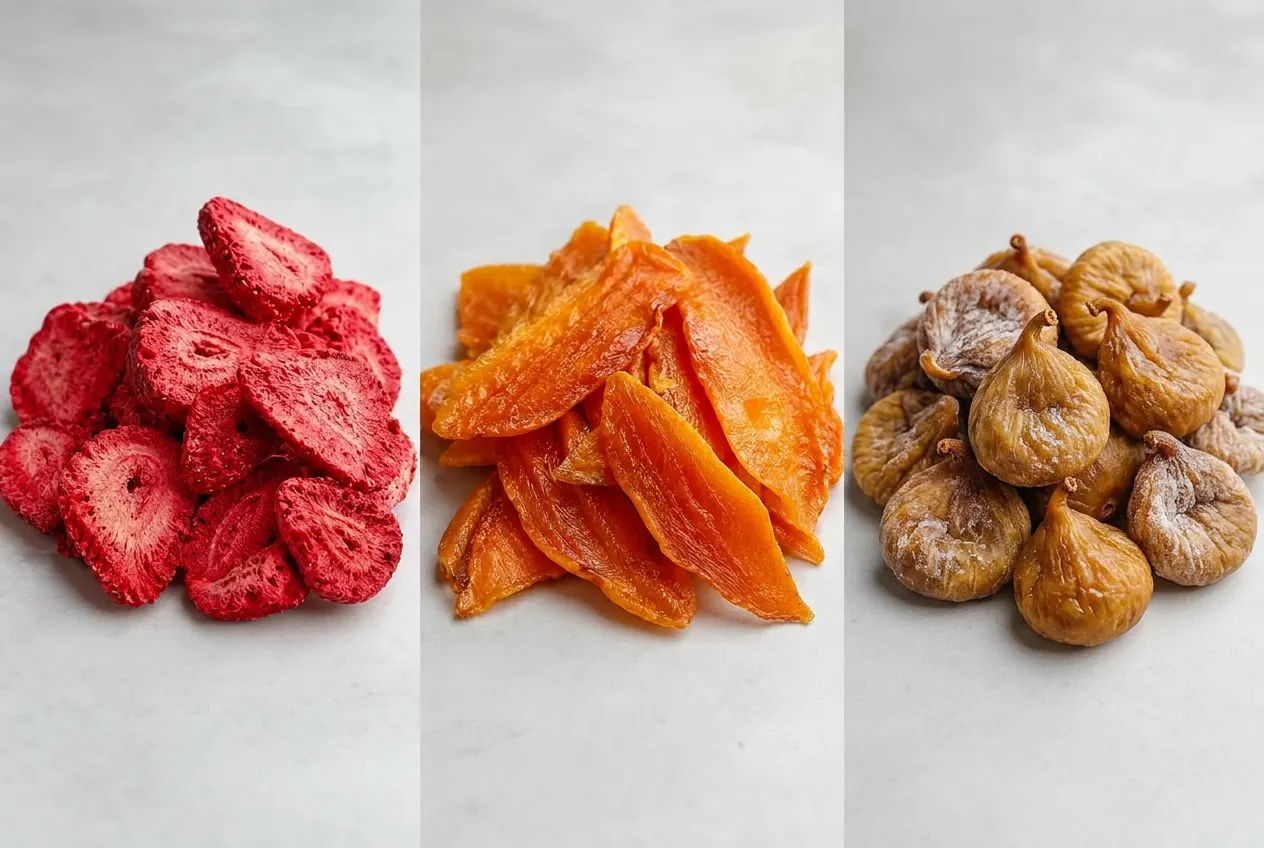
Dried fruit and vegetables are not one product - they are three completely different products depending on how the water was removed. Freeze drying, hot-air (heat) drying, and sun drying produce ingredients with different prices, textures, nutritional profiles, shelf lives, and applications. Buyers who specify the wrong method either overpay 5–10× for performance they don't need, or underpay and end up with a product their customer rejects. This guide breaks down what each method actually does, what it costs, and how to match the method to your downstream application.
What Freeze Drying (Lyophilization) Actually Is
Freeze drying removes water from frozen product by sublimation under deep vacuum - ice turns directly into vapor without ever passing through a liquid phase. Product is first frozen to roughly -30 to -40°C, then placed in a vacuum chamber at <1 mbar where mild heat drives the ice out as vapor over 18–36 hours per cycle.
Key physical characteristics: - Final moisture content typically 1.5–4% - Cellular structure preserved - the product retains its original shape and porous matrix - Color, flavor compounds, and heat-sensitive vitamins (C, B-complex) preserved at 90%+ of fresh - Crispy, light texture - rehydrates in seconds back toward fresh - Density is very low - a 100g bag of freeze-dried strawberries was originally ~900g of fresh fruit
Standard pack formats from Egyptian suppliers: - 5kg or 10kg foil-laminate bulk bags inside corrugated cartons, with oxygen absorbers - Retail pouches (15g–100g) with nitrogen flush for snack channel - Bulk drums (25kg) for industrial reformulation customers
Shelf life: 18–25 years at ambient (in sealed foil with oxygen barrier) - by far the longest of any drying method.
What Heat (Hot-Air) Drying Actually Is
Heat drying - also called hot-air drying, convection drying, or industrial dehydration - passes heated air (typically 55–80°C) over product spread on trays, belts, or in rotating drums for 6–24 hours until moisture drops to a target level. This is the dominant industrial drying method globally because the equipment is mature, throughput is high, and the cost per kilo of finished product is low.
Key physical characteristics: - Final moisture content typically 8–18% (depending on product and target) - Cellular structure partially collapsed - product shrinks 50–70% in volume - Color darkens from sugar caramelization and enzymatic browning - Heat-sensitive vitamins partially destroyed (vitamin C losses of 40–80% are typical) - Texture is chewy, leathery, or brittle depending on residual moisture - Rehydration takes 20–60 minutes and never fully recovers fresh texture
Standard pack formats: - 10kg or 25kg corrugated cartons with poly liner - 1kg retail bags - Bulk supersacks (500–1000kg) for ingredient buyers
Shelf life: 12–18 months at ambient in sealed packaging - adequate for most food-ingredient applications.
What Sun Drying Actually Is
Sun drying is the original drying method - product is spread on trays, mats, or racks in direct sunlight and dried by ambient solar heat and airflow over 3–10 days. In Egypt, it remains commercially significant for dates, apricots, figs, tomatoes, and certain herbs. Modern Egyptian sun-drying operations use raised stainless trays, food-grade netting to keep insects and dust off, and covered shade-drying yards rather than the bare-ground methods of 50 years ago.
Key physical characteristics: - Final moisture content typically 15–25% - wetter than industrial heat drying - Significant color change from sun exposure (often desirable - sun-dried tomatoes, golden apricots) - Flavor concentration is intense due to slow drying - distinct "sun-dried" flavor profile that buyers specifically request - Some nutritional loss but less severe than high-temperature heat drying for some compounds - Variable batch-to-batch quality depending on weather
Standard pack formats: - 5kg or 10kg cartons - Vacuum-packed retail pouches (200–500g) - the premium positioning - 25kg bulk for ingredient applications (pizza, ready meals, antipasti)
Shelf life: 8–12 months at ambient - shortest of the three, requires cool storage for premium retail product.
Side-by-Side: The Decision Matrix
Cost per kilo (FOB Egypt, indicative 2026): - Sun-dried: $3–$8/kg depending on product (tomatoes, apricots, figs) - Heat-dried: $4–$12/kg - Freeze-dried: $25–$60/kg - typically 5–10× the cost of heat-dried equivalent
Yield from 1 ton of fresh fruit: - Sun-dried: 200–300kg finished product - Heat-dried: 100–180kg - Freeze-dried: 80–150kg (depends on initial water content)
Nutritional retention vs fresh: - Freeze-dried: 90–97% of vitamins and bioactives - Sun-dried: 60–80% - Heat-dried: 30–60% (worst for vitamin C and thiamine)
Texture after rehydration: Freeze-dried recovers ~85% of fresh texture in 30 seconds. Heat-dried recovers ~50% over 30 minutes. Sun-dried doesn't fully rehydrate - it's typically eaten as-is.
Shelf life at ambient: Freeze-dried 18–25 years. Heat-dried 12–18 months. Sun-dried 8–12 months.
Energy cost per kg of water removed: Sun drying is essentially free (solar). Heat drying costs $0.08–$0.15/kg of water removed. Freeze drying costs $0.80–$2.00/kg of water removed - the dominant reason it's expensive.
Best for: Freeze-dried - premium snacks, infant nutrition, instant beverages, military and space rations, supplement ingredients, gourmet retail. Heat-dried - bakery inclusions, breakfast cereal, trail mix, soup mixes, industrial reformulation. Sun-dried - gourmet retail, pizza and Mediterranean ready meals, traditional Middle Eastern confectionery, premium tea and infusion blends.
Need a quote on the products in this article?
Send us your specs and we'll respond with FOB pricing, certifications, and references within one business day.
When Freeze Drying Is the Right Choice
Choose freeze drying if any of the following describe your application:
- The product is an instant-rehydration ingredient (instant soup, instant beverage, dairy inclusion that hits liquid)
- Visual recognition of the original fruit/vegetable shape is critical (premium snack, photographed packaging)
- Vitamin and bioactive retention is part of your product's value proposition (supplements, infant nutrition, functional foods)
- Shelf life of 5+ years at ambient is required (military, emergency, space, premium retail with long inventory cycles)
- Your product positioning supports a 5–10× ingredient cost premium (gourmet, clean label, premium snack)
- Your customer specifies "freeze-dried" by name - this is increasingly common in retail SKUs
In these applications, the freeze-drying premium is justified by performance the other methods cannot deliver.
When Heat (Hot-Air) Drying Is the Right Choice
Choose hot-air dried if any of the following describe your application:
- Cost per kilo of dried solids is your dominant criterion
- The product will be cooked, baked, or rehydrated in a hot process (cereal manufacturing, bakery, soup mix)
- Texture and visual quality of the individual piece doesn't drive consumer choice
- You're operating in mainstream food manufacturing rather than premium positioning
- Volume is high (full container loads, supersack packaging)
- Vitamin retention isn't part of your nutrition claims
For mainstream industrial food manufacturing, heat drying delivers the right cost-quality balance and is the global default for ingredient-grade dried fruit and vegetables.
When Sun Drying Is the Right Choice
Choose sun-dried if any of the following describe your application:
- The "sun-dried" descriptor is part of the product's marketing claim (sun-dried tomatoes, sun-dried apricots, sun-dried figs)
- Intense, concentrated flavor is the primary purchasing driver
- Mediterranean, Middle Eastern, or traditional positioning fits your brand
- The application is gourmet retail or premium ingredient (pizza, antipasti, ready meals, traditional confectionery)
- Slightly higher residual moisture (chewy texture) is a feature, not a defect
Sun-dried Egyptian product - particularly apricots, figs, dates, and tomatoes - commands a premium in EU and GCC retail channels precisely because of the flavor and traditional method.
Egyptian Supply - What's Different by Method
Egypt has a structural advantage in all three methods, but for different reasons:
Sun drying: 320+ days of sunshine per year, low humidity in Upper Egypt, and centuries of expertise in apricots, figs, dates, and tomatoes. Egyptian sun-dried apricot ("amar el-din"), sun-dried tomatoes, and sun-dried figs are globally recognized categories. FOB pricing typically 20–35% below Turkish or Spanish equivalents.
Heat drying: Modern industrial drying capacity has expanded significantly in the 6th of October and Beheira processing clusters since 2015. Top-tier facilities run BRCGS- and IFS-certified hot-air tunnel and band dryers for export-grade product. Pricing is competitive with Chinese supply for most products and significantly below European supply.
Freeze drying: A smaller and newer segment. Egypt has perhaps 8–12 commercial-scale freeze-drying facilities, mostly serving export markets. The advantage is access to peak-season fresh fruit and vegetable supply at a fraction of European raw material cost - which makes Egyptian freeze-dried strawberries, mangoes, and tomatoes meaningfully cheaper than European-origin equivalent. Lead times are longer (45–75 days from PO) due to the smaller capacity base.
Pesticide and residue compliance: All three methods, when sourced from top-tier Egyptian exporters, meet EU MRL standards. Always require a recent residue test (within 30 days of shipment).
How to Specify Your Order Correctly
Whichever method you choose, send your supplier a written specification before requesting a quote. Include:
For freeze-dried product: - Final moisture content (≤4% standard) - Cut and size grade (whole, sliced, diced, powder) - Color spec - Rehydration ratio target - Pack format (5kg or 10kg foil-laminate with oxygen absorber, nitrogen-flushed retail pouch) - Microbiological specification
For heat-dried product: - Target moisture range (e.g. 12–14%) - Drying temperature ceiling if required for nutrition claims - SO₂ treatment (yes/no - relevant for EU labeling and organic claims) - Cut, size grade, defect tolerance - Pack format and pallet configuration
For sun-dried product: - Moisture range (15–22% typical) - Color grade (often a Pantone or photograph reference - particularly for apricots and tomatoes) - Variety / cultivar - SO₂ treatment status - Origin region within Egypt (Upper Egypt vs Delta - affects flavor profile) - Insect and foreign matter tolerance
A 1-page spec sheet, signed by both parties, becomes the reference document for any future quality dispute.
Your Next Step
If you're evaluating dried fruit or vegetable supply, the most useful next move is to request quotes for the same fruit across two methods - for example freeze-dried strawberries vs heat-dried strawberries - and compare the per-kilo cost against your application's actual quality requirements. Many buyers discover the method they assumed they needed isn't actually the right one.
Alliance Foods supplies all three categories - Egyptian freeze-dried fruits and vegetables, hot-air dried product, and traditional sun-dried apricots, figs, and tomatoes - to importers across Europe, the GCC, and North America. We'll send you side-by-side quotes with sample availability and current FOB pricing, typically within one business day.
Frequently Asked Questions
What is the price difference between freeze drying and heat drying?
Freeze-dried product typically costs 5–10× more per kilo than equivalent hot-air dried product. The premium reflects the energy cost of vacuum sublimation, the longer cycle time (18–36 hours vs 6–24 hours), and the higher capital cost of freeze-drying equipment.
Which drying method retains the most nutrition?
Freeze drying retains 90–97% of vitamins and bioactives versus fresh. Sun drying retains 60–80%. Hot-air heat drying retains 30–60%, with the largest losses in vitamin C and thiamine due to heat exposure.
How long do freeze-dried, heat-dried, and sun-dried products last?
Freeze-dried product holds 18–25 years at ambient in sealed foil with oxygen absorbers. Hot-air dried product holds 12–18 months. Sun-dried product holds 8–12 months at ambient - shorter due to higher residual moisture.
Is sun-dried product safe and hygienic?
Yes - modern Egyptian sun-drying operations use raised stainless trays, food-grade netting, and covered shade-drying yards under HACCP and BRCGS controls. The bare-ground methods of decades ago are no longer used in export-grade supply chains.
Can freeze-dried product be rehydrated like fresh fruit?
Largely yes. Freeze-dried fruit rehydrates in 30–60 seconds and recovers approximately 85% of fresh texture, color, and flavor - far better than heat-dried (~50% recovery over 30 minutes) or sun-dried (which is typically consumed without rehydration).
Source from Egypt with confidence
Alliance Foods supplies importers across Europe, the GCC, the UK, and North America. Get a tailored quote in 24 hours.
Related products
Continue reading
The Complete Guide to Importing Frozen Vegetables from Egypt (2026)
Everything global buyers need to know to source IQF frozen vegetables from Egypt - from supplier vetting to FOB Damietta to landed cost in your warehouse.
IQF vs Blast Freezing: A Buyer's Guide to Choosing the Right Process
Two industrial freezing processes, two very different outcomes. A practical comparison for buyers specifying frozen produce contracts.