
Egyptian Frozen Okra Suppliers: A 2026 Buyer's Guide
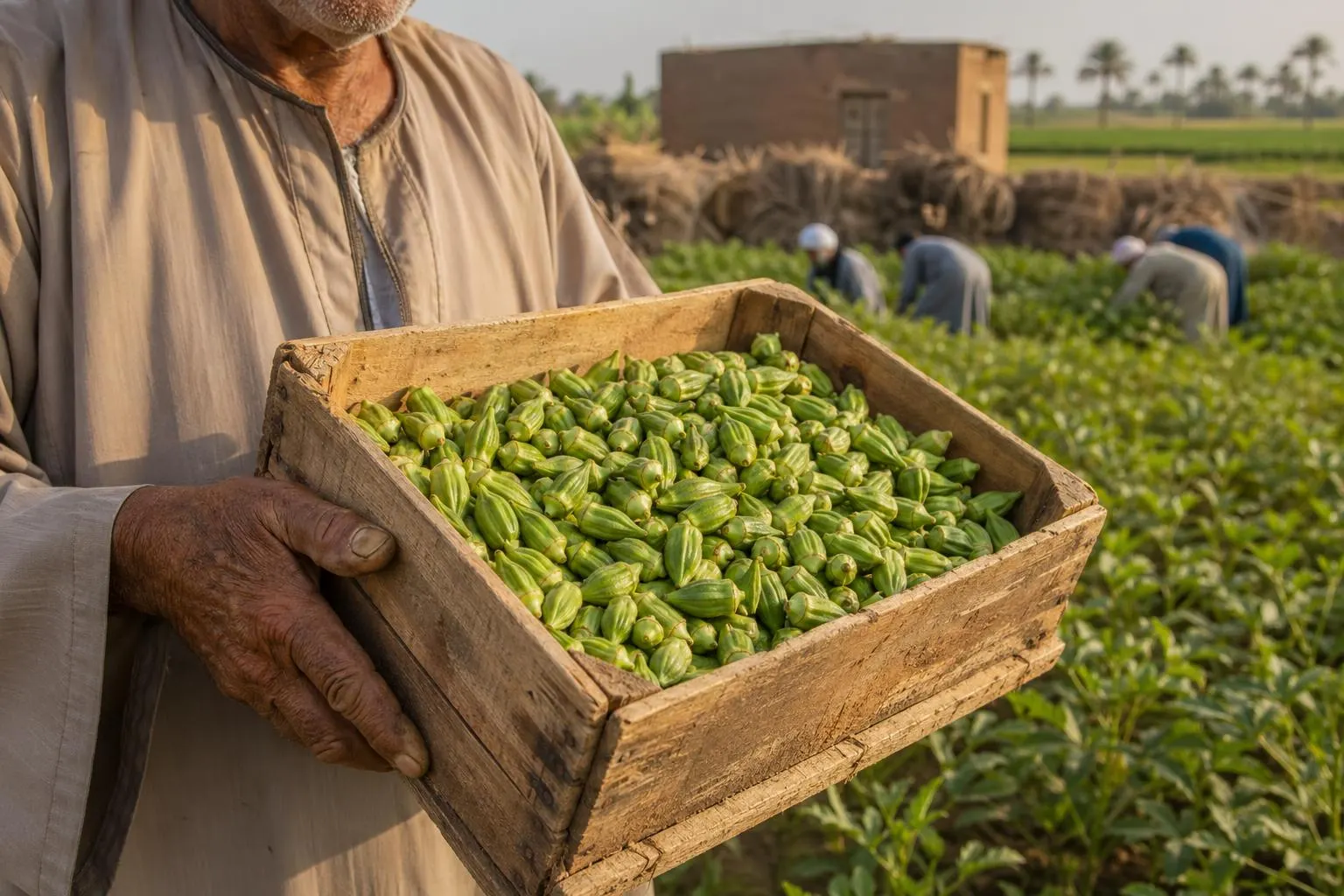
Egypt is the world's largest exporter of frozen okra, supplying buyers across the GCC, EU, UK, North America, and West Africa. The Nile Delta climate produces 8–10 months of harvest annually, and a concentration of HACCP and BRCGS-certified IQF facilities in the Cairo, Alexandria, and 6th of October industrial zones means that container-load supply is reliable in a way few competing origins can match. But the Egyptian frozen okra market is also full of brokers who present themselves as producers, exporters who subcontract production without disclosing it, and pricing that varies 30–40% for what looks like the same SKU. This guide explains how to vet a supplier, what specifications matter, and how to read an Egyptian frozen okra quotation.
Why Egypt for Frozen Okra
Egypt accounts for roughly 60% of global frozen okra trade. The advantages are structural and not easily replicated by other origins:
Climate: The Nile Delta supports two main okra crops per year (March–June and September–November) plus shoulder-season pickings, giving suppliers 8–10 months of fresh raw material per year. Suppliers in India, Turkey, and West Africa typically have 4–6 month seasons.
Variety: The dominant Egyptian variety, "Balady," is a small-pod cultivar (3–5 cm) prized in Middle Eastern, North African, and South Asian cuisines. Larger global producers often grow longer-podded varieties (8–12 cm) which command lower prices in those traditional markets.
Processing infrastructure: Egypt has more BRCGS / IFS / FSSC 22000 certified IQF okra lines than any other origin. The investment cycle of the past decade has built capacity specifically for export.
Logistics: FOB Damietta and FOB Alexandria offer 5–7 day transit to Mediterranean EU ports, 12–14 days to UK, 18–25 days to US East Coast - all on direct services, no transhipment.
Varieties and Cut Specifications
Whole okra: Pods frozen intact, typically calibrated by length: - Extra-small / "zero": 2–3 cm - premium grade for GCC retail - Small: 3–5 cm - standard Middle Eastern foodservice and retail - Medium: 5–7 cm - foodservice and food manufacturing - Large: 7–9 cm - typically destined for further processing or West African markets
Sliced okra: Cross-cut into 8–12 mm slices. Standard for soups, stews, and gumbo applications. Sold to US, West African, and EU foodservice.
Cut okra: Lengthwise or diagonal cut, typically 1.5–2.5 cm pieces. Used in Indian and South Asian channels.
A serious supplier will provide cut size distribution data with each batch - the ratio of in-spec to out-of-spec pieces in a typical 10 kg sample. Be sceptical of suppliers who only quote a single nominal size with no tolerance band.
How to Vet an Egyptian Okra Supplier
1. Verify they own the production line, not just the trading licence. Ask for a video walkthrough of the IQF facility, photos of the spiral freezer with the supplier's signage visible, and the BRCGS / FSSC 22000 certificate showing their company name as the certified site. Brokers will dodge this by sending stock photos.
2. Request a current COA from a recently shipped lot. Look for: micro counts (TVC, E.coli, Salmonella), pesticide panel (EU MRL compliance is the standard), heavy metals, and physical specs (temperature, drip loss, foreign matter).
3. Ask for three references - one from your destination region. A real exporter will have shipped to your destination market before and can provide a buyer reference. If the supplier dodges or only provides references from unrelated regions, this is a red flag.
4. Confirm certification scope. A facility may be HACCP-certified but only for one product line. Ask the supplier to send the audit report's product scope page, not just the certificate cover.
5. Check the FOB port matches the production location. A Cairo-based producer typically ships ex Damietta or Alexandria. If a supplier quotes FOB from a port hundreds of kilometres from their stated production address, they may be acting as a broker for someone else's production.
MOQ, Pricing, and Lead Times
Standard MOQ: 1× 40' reefer container, approximately 22–24 MT IQF okra depending on cut and packaging.
Pricing (indicative FOB Damietta, 2026): - IQF whole okra small (3–5 cm), 10× 1 kg retail: €1.85–€2.20/kg - IQF whole okra small (3–5 cm), 10 kg foodservice bag: €1.55–€1.80/kg - IQF sliced okra, 10 kg: €1.40–€1.70/kg
Prices vary with strawberry season demand on shared cold storage, fuel surcharges, and EUR/USD movement. Lock pricing for 60–90 days max - beyond that, suppliers will price-protect themselves with wide buffers.
Lead time: 30–45 days PO to FOB for new buyers (first lot through audit and approval). Repeat orders ship in 21–30 days. First-time private label can run 75–90 days due to artwork and packaging tooling lead time.
Need a quote on the products in this article?
Send us your specs and we'll respond with FOB pricing, certifications, and references within one business day.
Standard Documentation Pack
Every shipment from a serious Egyptian okra exporter should arrive with: - Commercial invoice and packing list - Bill of lading (B/L) - Certificate of Origin (COO) - chamber of commerce stamped - Certificate of Analysis (COA) - micro, pesticide, physical specs, lot-traceable - Health certificate from Egyptian Ministry of Agriculture - Phytosanitary certificate (where required by destination) - Halal certificate (for GCC, Malaysia, Indonesia destinations) - Insurance certificate (if CIF terms)
Missing or vague documentation at first shipment is the single most common warning sign that you are dealing with a broker rather than a producer.
Frequently Asked Questions
What is the MOQ for Egyptian frozen okra?
The standard MOQ is 1× 40-foot reefer container, approximately 22–24 metric tonnes depending on cut and packaging format. Mixed loads of okra with other Egyptian frozen vegetables can reduce the per-SKU minimum.
What is the price of frozen okra from Egypt?
Indicative 2026 FOB Damietta pricing: small whole IQF okra in 10 kg foodservice bags runs €1.55–€1.80/kg; sliced IQF okra in 10 kg bags runs €1.40–€1.70/kg. Retail bag formats add €0.20–€0.40/kg for packaging.
How long does shipping frozen okra from Egypt take?
5–7 days transit FOB Damietta or Alexandria to EU Mediterranean ports, 12–14 days to UK, 18–25 days to US East Coast, 7–10 days to GCC. All on direct reefer services, no transhipment required.
How do I know an Egyptian okra supplier is legitimate?
Ask for a video walkthrough of their IQF line, the BRCGS or FSSC 22000 certificate naming their company as the audited site, a recent batch COA, and three buyer references including one from your destination region. Brokers dodge these requests; producers have them on hand.
What okra varieties does Egypt export?
The dominant variety is 'Balady,' a small-pod cultivar (3–5 cm) preferred in Middle Eastern, North African, and South Asian markets. Larger calibres (5–9 cm) are also produced for West African and food manufacturing channels.
Source from Egypt with confidence
Alliance Foods supplies importers across Europe, the GCC, the UK, and North America. Get a tailored quote in 24 hours.
Related products
Continue reading

The Complete Guide to Importing Frozen Vegetables from Egypt (2026)
Everything global buyers need to know to source IQF frozen vegetables from Egypt - from supplier vetting to FOB Damietta to landed cost in your warehouse.

MOQ Explained: Minimum Order Quantities for Frozen Produce Imports
Why is the MOQ for frozen produce always one container? The answer is reefer economics, not supplier preference.