
Egyptian Food Exporter Certifications: What Every Importer Must Verify
Vetting an Egyptian supplier? Certifications are the first filter EU and GCC buyers apply - but most importers don't know which ones actually matter, which ones overlap, or how to check whether they're still current. A PDF alone proves nothing. This guide covers the five certifications that serious Egyptian food exporters hold, what each one guarantees across the supply chain, and the specific red flags that signal a supplier is cutting corners. If you're importing frozen vegetables from Egypt or any processed food product, this checklist is your verification framework before any contract is signed. Egyptian food exporter certifications are the internationally recognized standards - including HACCP, BRC/BRCGS, ISO 22000, GlobalGAP, and Halal - that verify a supplier's food safety practices at both the factory and farm level. They are required by EU, GCC, and global buyers as a condition of market entry and can each be independently verified through public online databases.
Why Certifications Matter When Sourcing from Egypt
Certifications protect EU and GCC buyers from the most costly risk in Egyptian food sourcing: a supplier who presents credentials they cannot substantiate. Egypt's food export sector reached $7 billion in 2025, up 12% year-on-year (AGBI, 2026). That growth means more qualified exporters - and more suppliers who present themselves as certified without the substance to back it up.
EU Market Entry Requirements
EU regulations distinguish between legal minimums and commercial expectations. Under Regulation (EC) 852/2004, HACCP-based food safety systems are a legal prerequisite for any food placed on the EU market. That is the floor. European retail chains - Tesco, Lidl, Aldi, Carrefour - then layer their own commercial requirements, typically BRC/BRCGS or ISO 22000, as a condition of doing business.
GCC and MENA Market Requirements
Gulf Cooperation Council buyers operate under a different compliance framework. Halal certification is non-negotiable for most GCC markets and is increasingly verified at destination ports. An Egyptian exporter supplying Dubai or Riyadh without a valid, recognized Halal certificate will face customs clearance problems regardless of how strong their other certifications are.
The Cost of Getting It Wrong
A rejected shipment at Rotterdam or Dubai can cost $10,000–$50,000 in demurrage, disposal, and emergency resourcing. Import bans at the product or supplier level can sever relationships that took months to build. Compliance verification done before the contract is signed costs nothing.
Alliance Foods holds HACCP documentation, BRC/BRCGS certification, and Halal certification - all verifiable through the databases referenced in this guide. Our IQF product lines ship from Alexandria and Damietta, Egypt's two principal export ports.
1. HACCP - The Foundation Every Supplier Must Have
HACCP is the legally mandatory food safety foundation that every Egyptian exporter must hold before supplying the EU market - without it, no other certification is sufficient for EU compliance. HACCP (Hazard Analysis and Critical Control Points) is a seven-principle systematic framework for identifying and controlling biological, chemical, and physical hazards in food production, developed under the Codex Alimentarius Commission and adopted as the international baseline for food safety management.
What HACCP Actually Covers
HACCP requires identifying every point in the production process where a hazard could be introduced (Critical Control Points), setting measurable limits at each CCP, monitoring those limits continuously, and maintaining records. It is process-focused - it controls what happens during production, not what gets tested at the end.
HACCP Is a Legal EU Requirement
Under EU Regulation 852/2004, all food business operators placing food on the EU market must implement and maintain HACCP-based procedures. This is not optional. An Egyptian exporter who cannot produce current HACCP documentation is legally ineligible to supply EU customers - regardless of any other certifications they hold.
What to Request
Ask for the HACCP plan document, CCP monitoring records from recent production, and the date of the most recent third-party audit. A genuine HACCP system produces continuous records - not a single certificate issued once and never revisited.
Red flag: A supplier who says they're "HACCP-compliant" but cannot produce documentation on request. HACCP is not a certificate - it is a documented system. No records means no system.
For a complete breakdown of HACCP documentation requirements, see our HACCP certification guide for importers - this article focuses on the four additional certifications that European and Gulf buyers typically also require.
2. BRC / BRCGS - The Standard European Retailers Demand
BRC/BRCGS is the certification that European retail chains require as a condition of supply - Egyptian exporters without it cannot enter Tesco, Lidl, Aldi, or Carrefour procurement programs. BRC (now BRCGS - British Retail Consortium Global Standard) was developed in 1998 by UK retail chains to create a consistent supplier audit framework (Action Audit, 2025). It is now applied globally across food manufacturing and processing, including Egyptian IQF factories operating alongside ISO 22000, HACCP, and other frameworks.
What BRC Covers Beyond HACCP
BRC goes further than HACCP. It includes facility environment standards, product authenticity and traceability requirements, and - since Issue 9 - a scored food safety culture assessment. A factory can have solid HACCP documentation and still fail BRC on culture, traceability gaps, or environmental contamination controls.
Who Requires It
Tesco, Lidl, Aldi, Carrefour, and the majority of European retail chain procurement programs require BRC or an accepted equivalent. For Egyptian IQF exporters targeting European retail supply chains - whether shipping through Alexandria or Damietta - BRC is effectively mandatory.
Grades: What to Accept and What to Reject
BRC issues certificates with grades: AA, A, B, and C. AA is the highest. Most serious EU retail buyers will only accept A or AA. A grade of C indicates significant non-conformances were found during audit - treat this with caution and ask for the corrective action plan before proceeding.
How to Verify
Search the BRCGS Directory at brcdirectory.com. Enter the company name or certificate number. The directory shows the current certificate, grade, scope, and expiry date in real time.
Red flag: A supplier who claims BRC certification but cannot be found in the BRCGS Directory. Certificates can be forged, expired, or issued under a slightly different trading name. Always check the live database - never rely on a PDF copy alone.
3. ISO 22000 - The Global Recognition Standard
ISO 22000 is a globally accepted food safety management standard recognized across international markets as an alternative to BRC for non-retail supply chains - accepted by manufacturers, distributors, and foodservice buyers who do not operate retail-specific procurement programs. ISO 22000 integrates HACCP principles with the ISO 9001 quality management framework, making it a comprehensive system that covers both food safety hazard control and management system discipline.
BRC vs. ISO 22000: When Each Applies
If your customer is a European food manufacturer rather than a retail chain, ISO 22000 is typically accepted. If your customer is a retailer or retail-facing distributor, require BRC. Some Egyptian processing facilities - particularly those in the 6th of October industrial zone west of Cairo - hold both certifications simultaneously to cover all buyer requirements.
Note on IFS: IFS (International Featured Standards) is another European retail standard, particularly prevalent in Germany and France. It is broadly equivalent to BRC but accepted by a different subset of retailers. If your end market includes German or French retail chains, ask whether your Egyptian supplier holds IFS Food in addition to BRC.
How to Verify
Request the certificate and note the issuing certification body. Then verify that body is accredited by a recognized national accreditation authority - UKAS (UK), DAkkS (Germany), COFRAC (France), or their equivalent under the IAF Multilateral Recognition Arrangement (MLA). An ISO 22000 certificate issued by an unaccredited body carries no meaningful assurance.
Red flag: An ISO certificate from a certification body that does not appear in the UKAS register or IAF MLA database.
Need a quote on the products in this article?
Send us your specs and we'll respond with FOB pricing, certifications, and references within one business day.
4. GlobalGAP - Farm-Level Certification Competitors Skip
BRC and ISO 22000 cover the factory. GlobalGAP covers the farm - and for fresh and frozen produce, the safety chain starts long before a product reaches a processing facility. For Egyptian IQF frozen vegetables sourced from Nile Delta farms - where strawberries, artichokes, green beans, peas, and sweet corn are grown at export scale - farm-level certification directly determines whether raw material meets European MRL thresholds before processing even begins.
What GlobalGAP Covers
GlobalGAP (Good Agricultural Practices) is a private-sector standard applied at the primary production level. It governs pesticide use, irrigation water safety, soil management, worker welfare, and traceability from farm to packing house. GlobalGAP-certified Nile Delta farms demonstrate that the raw material entering the IQF processing facility already meets baseline European standards before any freezing or packaging takes place.
Why It Matters for EU Buyers of IQF Produce
EU buyers sourcing frozen vegetables operate under Maximum Residue Limit (MRL) regulations for pesticides. A shipment that exceeds EU MRL thresholds can be rejected or destroyed at European customs - even if the exporting factory holds BRC certification. GlobalGAP-certified farms maintain pesticide application records and undergo annual audits that directly address MRL compliance. Factory certification alone cannot close this gap.
For a deeper look at how processing quality connects to raw material inputs, see IQF processing and what it means for quality.
How to Verify
Search the GlobalGAP database using the supplier's GGN (GlobalGAP Number). Each certified farm or farm group has a unique GGN searchable in the public database.
Red flag: A supplier who claims GlobalGAP compliance for their contracted farms but cannot provide individual GGN numbers. Without GGNs, farm-level compliance is unverifiable.
5. Halal Certification - Required for GCC, MENA, and Southeast Asian Markets
For buyers supplying GCC countries, MENA markets, or Muslim-majority Southeast Asian markets, Halal certification is a commercial and in many cases legal requirement - not a buyer preference. For Egyptian exporters, Halal certification also signals processing discipline that benefits all buyers, as the controls required for Halal compliance overlap significantly with general quality segregation and cross-contamination prevention practices.
Why IQF Vegetables Need Halal Certification Too
Even for plant-based frozen produce, Halal certification matters. Shared processing lines, cleaning agents containing animal derivatives, and cross-contamination from other product categories can all affect Halal status. A Halal certificate for a vegetable processing facility certifies that the facility's processes, cleaning procedures, and ingredient inputs comply with Islamic law as defined by the certifying body.
The Egyptian Standard
Egypt's current formal Halal production standard is ES 4249/2023, issued by the Egyptian Organization for Standards and Quality (EOS) in August 2023 - replacing the previous ES 4249/2014. Egyptian exporters targeting Gulf markets should hold certification referencing this updated standard, issued by a body recognized in their destination market (ISEG Halal).
Recognized Issuing Bodies
ISEG Halal is one recognized Egyptian Halal certification body. The Islamic Chamber Research and Information Centre (ICRIC) is another. GCC countries each maintain their own approved body lists - verify that the issuer is on your specific destination market's approved list before accepting any certificate.
How to Verify
Request the certificate, check the scope (which products and processing lines are covered), and verify the expiry date. A Halal certificate that covers only one product category is not a blanket endorsement of the full facility.
Red flag: A Halal certificate issued by an unrecognized body, or one that does not specify scope. Destination market customs authorities check both.
The Complete Certification Checklist for Vetting Egyptian Suppliers
The following checklist covers the five certifications every serious Egyptian food exporter should hold, the buyers who require them, and where to verify each one independently - without relying on the supplier.
Not sure which certifications your market requires? Contact Alliance Foods - our team works with EU, GCC, and Asian importers daily and can advise on exactly what documentation your buyers will expect.
Additional Documents to Request Before Signing
Certifications establish a supplier's system quality. These operational documents establish batch-level accountability and are equally essential before committing to any Egyptian frozen food supplier:
- Certificate of Analysis (COA): Issued per production batch. Shows microbiological, physical, and chemical test results for that specific lot. Request COAs from at least two recent production runs.
- Product Specification Sheet (PSS): Full technical specification including nutritional data, pack sizes, shelf life, and storage conditions.
- Shelf Life Documentation: Test data or historical records supporting the claimed shelf life under standard storage conditions.
- Factory Audit Report: The most recent third-party audit report - not just the resulting certificate. The full report reveals non-conformances and the corrective actions taken in response. A clean certificate with a report full of observations tells you far more than the grade alone.
Alliance Foods provides complete documentation packs - including current certificates, COA templates, and product spec sheets - on request before contract commitment. Questions about minimum order quantities for frozen produce imports can be addressed at the same stage.
How Alliance Foods Approaches Certification
Alliance Foods is an Egyptian B2B food exporter holding HACCP documentation, BRC/BRCGS certification, and Halal certification, with GlobalGAP-certified contracted Nile Delta farms supplying our IQF product lines including frozen strawberries, artichokes, green beans, peas, and mixed vegetables. All certifications are current and verifiable through the live databases referenced throughout this guide.
We treat certification as a buyer assurance, not a marketing claim. Every inquiry includes access to our full documentation pack so buyers can verify before they commit - not after the order is placed. Products ship via Alexandria and Damietta under standard international trade terms.
Request our full documentation pack - including certificates, COA templates, and spec sheets - before you commit to a supplier.
Request Documentation Pack →
Frequently Asked Questions
What certifications should an Egyptian food exporter have?
At minimum, a serious Egyptian food exporter should hold HACCP documentation (legally required for EU exports under Regulation 852/2004), plus at least one of BRC/BRCGS or ISO 22000 for their processing facility. GlobalGAP at farm level and Halal certification are additional requirements depending on your target market - GCC and MENA buyers require Halal; EU retail buyers increasingly require GlobalGAP.
How do I verify a BRC certificate from an Egyptian supplier?
Look up the supplier in the official BRCGS Directory at brcdirectory.com. Enter the company name or certificate number to check their current grade (AA, A, B, or C), scope, and expiry date. Never rely on a PDF alone - certificates can be forged or expired. The directory is the only authoritative real-time source for confirming BRC status.
Is GlobalGAP certification necessary for importing frozen vegetables from Egypt?
GlobalGAP certification is increasingly expected by European buyers, particularly for retail supply chains. It covers farm-level practices - pesticide use, water safety, worker welfare - that factory certifications like BRC do not. EU buyers subject to MRL (Maximum Residue Limits) audits should require GlobalGAP GGN numbers from suppliers' contracted Nile Delta farms before placing any order.
Do I need Halal certification if I'm buying frozen vegetables from Egypt?
Yes, if you're supplying to GCC countries, MENA markets, or Southeast Asian Muslim-majority markets. Even for vegetables, shared processing lines can affect Halal status. Request a Halal certificate that specifies scope and was issued by a body recognized in your destination market. Egypt's current Halal standard is ES 4249/2023 (updated from ES 4249/2014 in August 2023), issued by recognized bodies including ISEG Halal and ICRIC.
What documents should I request from an Egyptian frozen food supplier before signing a contract?
Request: current HACCP documentation, BRC or ISO 22000 certificate (with live database verification), GlobalGAP GGN numbers for contracted farms, Halal certificate (if applicable), Certificate of Analysis (COA) for the latest batch, product specification sheet, and the most recent third-party audit report. All serious Egyptian exporters - including those shipping from Alexandria or Damietta - should supply this pack without hesitation.
What is FSSC 22000 and does an Egyptian food exporter need it?
FSSC 22000 (Food Safety System Certification 22000) is a GFSI-recognized standard that combines ISO 22000 with additional sector-specific requirements. It is accepted by major food manufacturers globally and is gaining adoption among Egyptian processing facilities in industrial zones targeting premium European buyers. While not as universally required as BRC, FSSC 22000 signals advanced food safety management maturity and is worth requesting from suppliers targeting large manufacturing accounts.
How do EU importers verify Egyptian food supplier certifications without visiting the factory?
EU importers can independently verify most Egyptian supplier certifications using free online databases: the BRCGS Directory (brcdirectory.com) for BRC grades, the GlobalGAP database (globalgap.org) for farm GGN numbers, and national accreditation body registers (UKAS, DAkkS, COFRAC) for ISO 22000 issuing bodies. Only HACCP and Halal require direct documentation requests from the supplier, as no single public database indexes them.
Source from Egypt with confidence
Alliance Foods supplies importers across Europe, the GCC, the UK, and North America. Get a tailored quote in 24 hours.
Related products
Continue reading
The Complete Guide to Importing Frozen Vegetables from Egypt (2026)
Everything global buyers need to know to source IQF frozen vegetables from Egypt - from supplier vetting to FOB Damietta to landed cost in your warehouse.
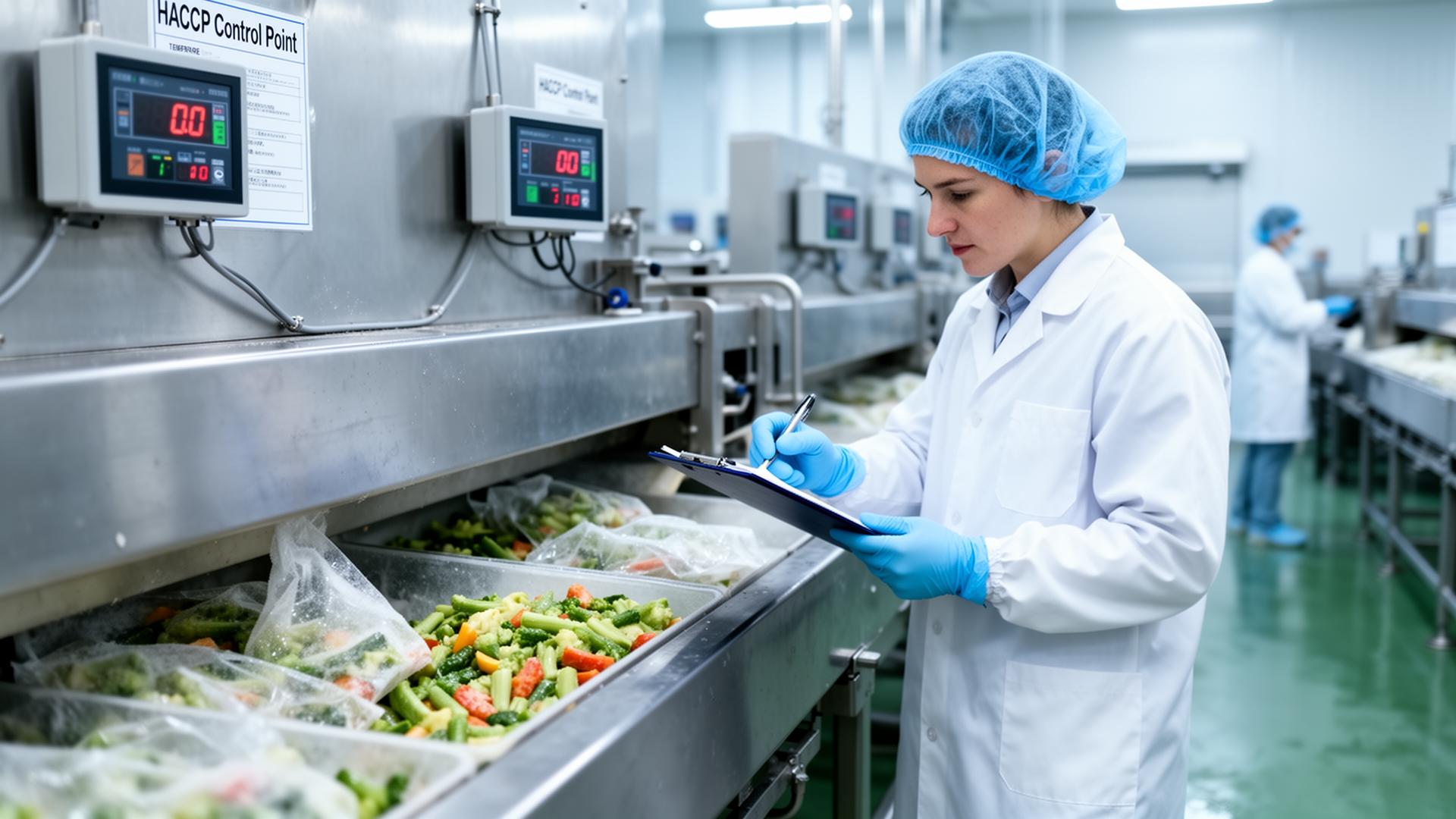
HACCP Certification Explained: A Practical Guide for Food Importers
HACCP is the foundational food safety framework most exporters claim - but verifying the claim takes more than reading a certificate.